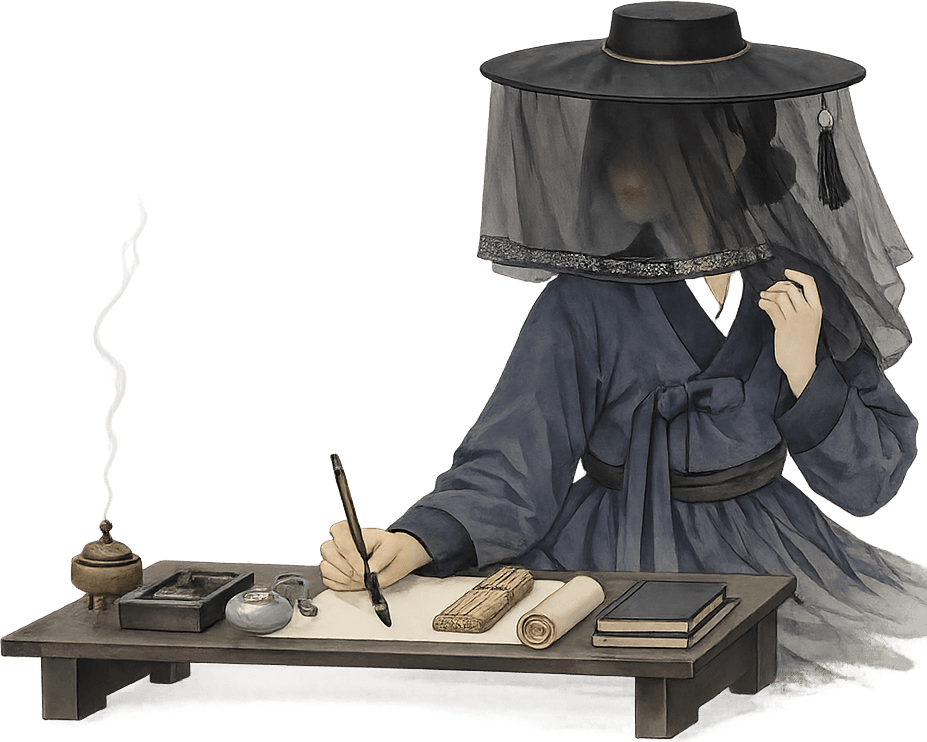
Korean Saju · 사주 · Four Pillars of Destiny
The writing you were born under
Mitgeul builds your Saju chart - the four pillars of Korean astrology - from the date, time, and place you were born, and reads what those eight characters say about you.
Free, no account, nothing to cancel.
What saju is
Eight characters, read from the moment you were born
Saju (사주, 四柱) is the Korean reading of the Four Pillars of Destiny — the same system Chinese practice calls BaZi. Your birth year, month, day, and hour each get a pillar, and each pillar is written with two characters: a heavenly stem above, an earthly branch below. Eight characters in total. That is your chart.
The stem of your day pillar is you. Korean readers call it the Day Master, and everything else is described by how it stands toward that one character — what feeds it, what drains it, what it can’t reach.
Korea kept its own reading tradition around these eight characters for a thousand years. Most English-language sites give you the Chinese reading of them. Mitgeul gives you the Korean one, and prints both names for every character so you can follow either.
Five elements · 五行
What your eight characters are made of
Every stem and branch carries one of five elements. Counting them tells you what your chart leans on and what it has none of — and in saju an element you lack isn’t a fault to fix. It’s usually the thing you go looking for in other people.
- Wood 木reaching, growing, beginning
- Fire 火showing, warming, being seen
- Earth 土holding, steadying, enduring
- Metal 金cutting, deciding, finishing
- Water 水flowing, soaking, adapting


Why calculators disagree
Two sites, one birthday, different characters
Most free calculators say charts “may vary between sources.” None of them say by how much. We measured it — the same births, our policy against one changed assumption at a time:
- 38.4%
- of charts come out different if clock time isn't corrected to true solar time.A time zone is one number for a whole country. The sun doesn't agree with it.
- 13.8%
- of charts come out different if the equation of time is skipped.Earth's orbit is an ellipse, so the sun runs up to a quarter-hour early or late depending on the season.
- 4.1%
- of charts come out different if the day is taken to start at midnight.In saju the day turns at 11pm, when the Rat hour begins — not at midnight.
Mitgeul applies all three, plus the historical standard-time shifts most tools miss, and checks the result character by character against Korean and Hong Kong national almanac data. It’s also why we ask where you were born — a birth time without a place is about half an hour of guesswork, and half an hour moves the hour pillar.
What you get, free
The whole skeleton, no account
- Your four pillars in full — stem and branch, each with its Chinese character and its Korean reading.
- Your Day Master: the single character saju reads you from, and what that character tends to mean.
- Your five-element balance — what your chart leans on, what it's thin in, what's missing entirely.
What we’re still writing in English is the reading itself — how the eight relate to each other, and which stretch of years turns the balance. Build your chart and you can ask us to tell you when it opens.
Your chart is read by Binhoek, who keeps this desk. He doesn’t tell you what will happen. He tells you what was already written down, and leaves the rest to you.